Quick answer (operator decision)
Sell gift vouchers (gift cards) when you need a simple prepay product and can let the customer choose the details later.
Sell experience packages when you need to lock in what’s included and protect capacity and margin.
Use a hybrid if you want easy gifting but controlled delivery: voucher purchase, package-style redemption.
Watch-outs: vouchers can create peak redemption spikes and admin; packages can cause friction if availability or costs change.
Monetary vs experience vouchers: which should an operator sell?
This isn’t a debate about gifts. It’s a choice about prepaid revenue and fulfilment control.
A gift voucher (gift card) can be sold as monetary value (stored credit redeemed later) or as an experience voucher (a defined service or bundle, delivered later).
The real question is where uncertainty sits, and whether your operation can absorb it.
Definitions (for consistency across regions)
Gift card / gift voucher / gift certificate / experience voucher (gift experience): different labels operators use for prepaid vouchers. The wording varies by region and by business, but the underlying concept is the same: customers pay now and redeem later.
Two common voucher formats:
- Monetary voucher: a stated cash value (for example, £50) that can be redeemed against eligible services (unless you apply restrictions).
- Experience voucher (gift experience): a voucher sold as a defined experience, either one service (for example, “afternoon tea”) or a bundle/package (for example, “spa treatment + lunch”), delivered later under stated rules.
The real operator question: where does uncertainty sit?
Both monetary vouchers and experience vouchers take payment upfront and are redeemed later. In most cases, the guest still chooses the booking date and time after purchase.
The difference is what is fixed at the point of sale:
Monetary vouchers keep the product choice open. The buyer selects a value (for example, £50) and the recipient decides later what to spend it on. That flexibility reduces purchase friction, but it can increase “what can I use this for?” queries and makes demand harder to steer unless your redemption rules and booking journey are tight.
Experience vouchers fix the product, not the schedule. The buyer commits to a defined experience (one service or a bundle), but the date and time are usually booked later within the validity window. This helps you protect margin and delivery consistency because inclusions are clear. The trade-off is obligation: if you can’t deliver that specific experience as sold, you’re managing substitutions, refunds, and goodwill.
For mainly countries like the UK, voucher structure can matter for VAT or Sales Tax treatment, so it’s worth aligning definitions early with your tax authorities' guidance.
When should an operator sell monetary gift vouchers (gift cards)?
Best when: you want one simple prepay product, and you’re happy for the recipient to choose the service later.
Monetary vouchers fit operations with a wide range of services, variable availability, or gift buyers who can’t confidently pick the right experience.
Watch for: more questions at redemption and more peak pressure if booking rules aren’t tight. Expect “what can I use this for?”, partial-use admin, and upgrade difference-charging to become recurring work.
When should an operator sell experience vouchers (gift experiences)?
Best when: you want the booking date to stay flexible, but you need clarity on what will be delivered.
Experience vouchers work well when inclusions can be defined cleanly (one service or a bundle), when margin control matters, or when capacity and partner delivery need tighter rules.
Watch for: obligation. If inclusions, partners, or operating conditions change, you’ll see more substitution, goodwill, and refund conversations because the customer bought a specific experience.
Comparison table: monetary vouchers vs experience vouchers
| What changes for the operator | Monetary voucher (gift card) | Experience voucher (gift experience) |
| Buyer effort at purchase | Lowest | Slightly higher |
| What’s fixed at purchase | Value only | The experience (service/bundle) |
| Capacity and peak control | Needs strict booking rules | Easier to steer with defined offers |
| Support load | More eligibility/partial-use questions | More substitution/expectation questions |
| Margin control | Can leak through upgrades/goodwill | Stronger through defined inclusions |
| Main dispute risk | “What can I use this for?” + balance/terms | “Deliver as described” + substitutions |
The practical middle ground: voucher controls and add-ons
Most operators don’t choose one format and stop. They add simple controls to protect peak capacity, and add-ons to lift value without creating redemption arguments.
Controlled monetary vouchers
What it is: a cash-value voucher with clear rules, for example weekday-only, off-peak only, or limited to a department (spa-only, dining-only).
Why it works: the product stays easy to buy, but you gain a lever to steer demand and protect peak slots.
Watch-outs: if restrictions feel hidden or inconsistently applied, disputes rise. Put the rule in plain language at purchase and apply it the same way every time.
Experience vouchers with add-ons
What it is: a defined experience voucher with optional upgrades at purchase (for example weekend upgrades, add-on elements, extended duration).
Why it works: the experience stays defined, but buyers can personalise and trade up without you relying on staff to negotiate at redemption.
Watch-outs: upgrades must be priced and applied consistently, or you’re back to manual exceptions.
Which to use? If peak capacity is the risk, start with controlled monetary vouchers. If margin drift and substitutions are the risk, start with experience vouchers and clearly priced add-ons.
Redemption check: is the booking path clear?
With a good voucher management system, both monetary and experience vouchers can be easy to redeem. The operational difference shows up when your booking path and rules aren’t clear.
If customers can self-serve redemption and booking, either format scales well. If redemption relies on staff manually interpreting terms, support load rises, and small exceptions become routine. The voucher format matters less than whether redemption is predictable and self-serve.
Voucher economics: overspend and breakage (useful, but not guaranteed)
Voucher programmes often show breakage (unused vouchers) and overspend (spend above voucher value). A hotel industry guide reports both patterns in hotel voucher sales. (hotelcms-production.imgix.net)
Treat these as variables, not promises. Breakage can trigger disputes if policies are unclear or feel unfair. Overspend is far more likely when booking is smooth and upgrades are easy to purchase, and far less likely when availability is constrained.
Expiry, refunds, and legal risk (decision-level)
Rules vary by jurisdiction, but the risk profile differs by voucher format.
Monetary vouchers tend to trigger balance and eligibility questions: what the value can be used for, what’s excluded, and disputes about terms, fees, or expiry.
Experience vouchers tend to trigger delivery questions: whether the experience matches what was sold, substitutions, and cancellations when the original experience can’t be delivered.
US (federal vs state): there’s a federal baseline on gift card expiry and fees, and state law can add extra rules. For the plain-English breakdown, see: https://enjovia.com/gift-card-expiration-date-federal-law/
UK (refunds): outcomes depend on the situation, but most disputes come down to policy clarity and consistency. For common scenarios, see: https://enjovia.com/gift-card-refund-law/
For a cross-market view of expiry approaches, see: https://enjovia.com/gift-card-expiration-law
If you want a practical way to reduce disputes, this wording template shows how operators can write voucher terms clearly (including restrictions and redemption rules): https://enjovia.com/gift-certificate-wording-template/
How to tell if your voucher setup is working (first 90 days)
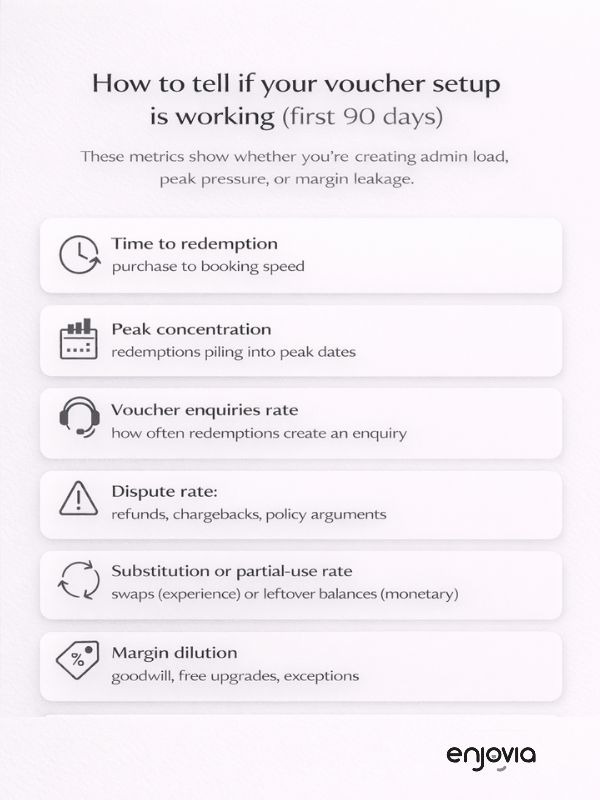
These metrics show whether you’re creating admin load, peak pressure, or margin leakage.
- Time to redemption: purchase to booking speed
- Peak concentration: redemptions piling into peak dates
- Voucher enquiries rate: how often redemptions create an enquiry
- Dispute rate: refunds, chargebacks, policy arguments
- Substitution or partial-use rate: swaps (experience) or leftover balances (monetary)
- Margin dilution: goodwill, free upgrades, exceptions
Monetary Voucher vs Experience Voucher - Voucher format checklist (30 seconds)
Tick the statements that are true.
Lean MONETARY voucher (gift card) if:
- Buyers want to choose the amount, not the experience
- You want one simple option that works across many services
- You’re comfortable with partial use and leftover balances
- Flexibility matters more than steering redemptions
Lean EXPERIENCE voucher (gift experience) if:
- You need to lock in inclusions to protect margin
- Peak capacity is tight and you need stronger control
- You want clearer expectations and fewer “what can I use this for?” queries
- Your experiences are repeatable and easy to define
If you ticked both: keep purchase simple, then add controls (peak/weekday rules) and add-ons (priced upgrades) to avoid negotiation at redemption.
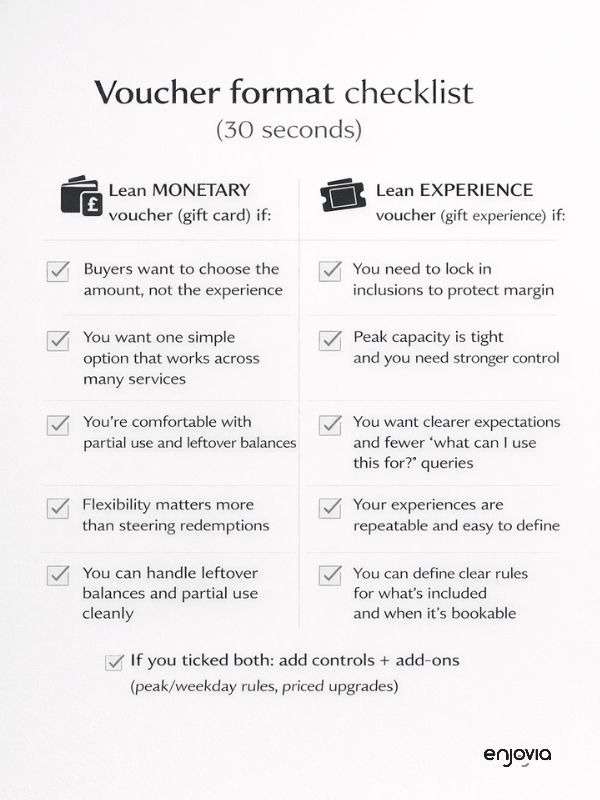
The simplest decision rule- Monetary Voucher vs Experience Voucher
If your biggest problem is purchase friction, lead with monetary vouchers.
If your biggest problem is delivery control, lead with experience vouchers.
If you need both, keep purchase simple but use controls (peak rules) and add-ons (priced upgrades) so redemption doesn’t turn into negotiation.
Next step: If you want to reduce disputes, use this voucher terms wording template: https://enjovia.com/gift-certificate-wording-template/
FAQ
Can we sell both monetary and experience vouchers without confusing guests?
Yes, as long as the difference is obvious at purchase. Monetary vouchers should be framed as “value to spend”, while experience vouchers should show exactly what’s included. Confusion usually comes from vague naming and unclear redemption rules, not from offering both.
Should we restrict monetary vouchers to off-peak or weekdays?
Restrict them when peak capacity is the constraint and you need a lever to steer demand. Keep restrictions simple (weekday-only or off-peak only), display them clearly before payment, and apply them consistently to avoid disputes.
What causes the most disputes with monetary vouchers?
Eligibility and policy clarity: what the voucher can be used for, what’s excluded, whether it can be split across visits, and how upgrades or price differences are handled. Clear terms and a predictable booking path prevent most problems.
How do we reduce exceptions and “can I change this?” requests on experience vouchers?
Make the inclusions and booking rules explicit at purchase: what’s included, what isn’t, when it can be booked, and how upgrades are priced. The fewer grey areas you leave, the less your team has to interpret requests at redemption.
Related Articles
Ready to Grow Your Gift Voucher Sales like the Celtic Manor?
Let’s chat about what your existing system looks like, and how Enjovia can accelerate your sales and improve your processes.