Gift vouchers vs discounts for UK hotels
Most independent hotels reach for discounts when a week looks light. It’s understandable, but it can also reset your public price in a way that’s hard to unwind.
Gift vouchers are often the safer choice when you want to hold your prices and sell stays, meals, or experiences as gifts.
They can bring cash forward, but the bigger advantage is that they let you sell value in advance without teaching guests to wait for deals.
Discounts still have a place, especially for genuinely empty, perishable inventory in defined low-demand windows, but they need tight fences and clear measurement.
Decision rule (UK independents)
If you want to protect rate and sell giftable experiences in advance, vouchers are usually the safer lever. If you need to clear genuinely empty low-demand dates, discounts can work, but only when they are fenced and measured on contribution after variable costs and displacement risk.
Jump to (clickable anchor links)
- Should you use vouchers or discounts?
- Gift vouchers: when they work, where they go wrong, what to measure
- Discounts: when they work, where they go wrong, what to measure
- UK compliance: voucher VAT and pricing claims
- How to measure success (two scorecards)
- FAQs
Should you use vouchers or discounts?
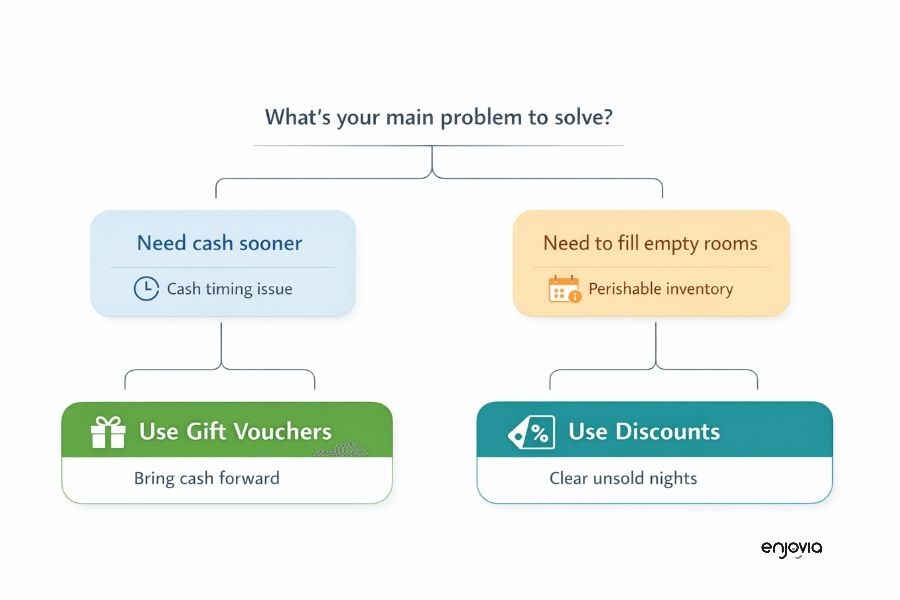
Before you choose a tactic, be clear what you’re trying to fix.
- Need to bring money forward without cutting public prices? Vouchers usually fit better.
- Need to fill specific quiet dates or time slots that would otherwise go unsold? A fenced discount can work, a discount with tight rules (dates, lead time, length of stay, audience, and inventory caps) so it clears quiet nights without teaching the market your new ‘normal’ price.
Gift Vouchers vs Discounts for UK Hotels - Gift vouchers (how they work, where they bite, what to track)
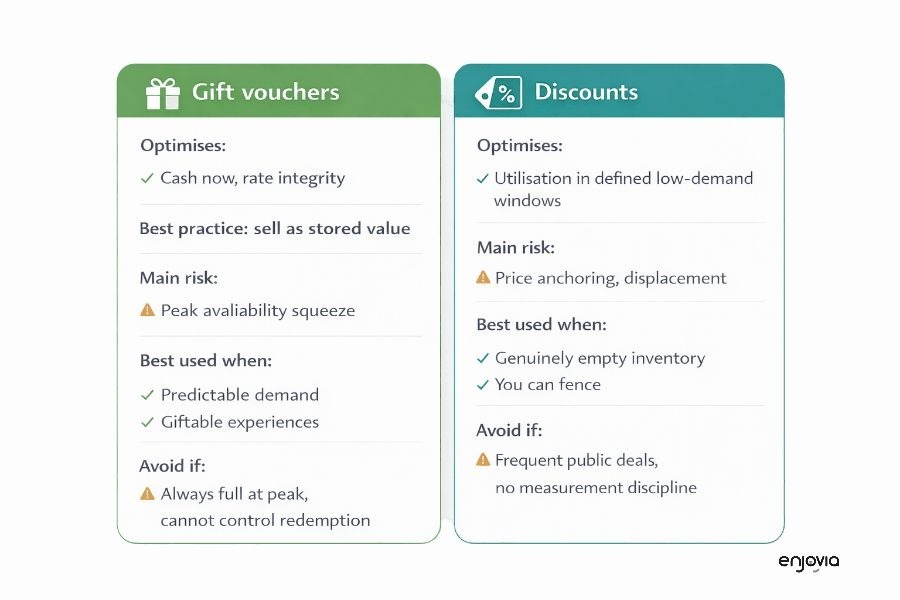
Gift vouchers let you sell stays, dining and experiences in advance without cutting your public price. The guest gets credit or a defined experience package. You get earlier revenue and a giftable product.
Two voucher formats, two risk profiles
- Stored value (recommended): acts like credit, so you keep rate integrity.
- Fixed-price packages (needs care): can become cheap on peak dates unless you use “from” pricing, supplements, or date rules.
Use vouchers when
- You want to protect rates but still create reasons to buy now.
- You have giftable experiences beyond rooms (lunch, afternoon tea, spa, seasonal menus).
- You can manage redemption so it doesn’t concentrate on peak weekends.
Where vouchers can go wrong
- Redemptions pile into peak periods because there’s no plan for availability.
- Costs rise between sale and redemption and margin gets squeezed.
- Terms aren’t clear, so your team ends up negotiating at reception.
If you want UK-specific background on the gift voucher law and expiry dates read more here: https://enjovia.com/gift-card-refund-law/
Avoid pushing vouchers hard if
- You’re consistently full at peak and can’t control redemption timing.
- Redemption is manual or clunky (lots of exceptions, phone calls, back-and-forth).
- You’re already under service pressure.
What to track (monthly)
- Voucher sales value and channel mix
- Redemption timing and redemption rate (by month of issue)
- Peak vs off-peak redemption mix
- Average time-to-redeem
- Uplift on redemption (spend above voucher value)
- Guest friction (refund requests, booking complaints)
Optional context on why experience-led offers hold value better than blunt price cuts:
Why experience-led vouchers convert
Here’s one example of a hotel using vouchers as an advance sales channel at scale (useful for context, not a benchmark): Celtic Manor voucher sales example
Discounts (when they work, where they backfire, what to track)
Discounts are a price lever. They can fill genuinely empty dates, but they also teach the market what your lowest price looks like. The safest way to use them is as a fenced, time-bound clearance tool.
Use discounts when
- You have inventory that will otherwise go unsold in a defined window.
- You can fence it by dates, lead time, length of stay, and audience.
- You can measure contribution after costs, not just pickup.
Fence it like an operator
- Midweek only (or Sun–Thu only)
- Advance purchase (reduces last-minute cannibalisation)
- Minimum length of stay in shoulder periods
- Member or email-only access (avoid public anchoring)
- Tight inventory limits
Where discounts go wrong
- Displacement: bookings that would have happened at a higher rate without the discount.
- Price anchoring: the discounted price becomes the “real” price in guests’ minds.
Discounting can create bookings fast, but it can also give away rate you didn’t need to give away. Cornell’s hotel pricing research found a recurring pattern: hotels that undercut similar nearby competitors often see occupancy rise, while RevPAR performance falls behind that same group.
Source: Canina & Enz (2006), Cornell Center for Hospitality Research,Why Discounting Still Doesn’t Work: A Hotel Pricing Update.
Avoid broad discounting if
- You can’t clearly say which inventory it’s meant to clear.
- You’re discounting so often that guests learn to wait.
- You can’t measure contribution after variable and channel costs.
What to track (per campaign)
- Incremental contribution after variable costs and channel costs
- Channel costs (OTA commission, paid media, card fees)
- Displacement estimate (even if rough)
- Booking window shift (pulled forward vs genuinely new)
- Repeat behaviour without a discount
- Rate integrity signals (deal-only behaviour, price matching)
UK compliance: promotional pricing claims
This isn’t legal advice, but if you show savings (“was/now”, “20% off”), countdown timers, or scarcity messages, make sure you can evidence the reference price and present the offer transparently. The CMA has published compliance advice on pricing and urgency claims for businesses.
Source: CMA compliance advice (open letter). (assets.publishing.service.gov.uk)
How to measure success (so you don’t fool yourself)
It’s easy to convince yourself something “worked” because you saw activity. Voucher sales come in. Occupancy ticks up. The only way to avoid fooling yourself is to measure each lever on the metric that matches what it’s actually doing.
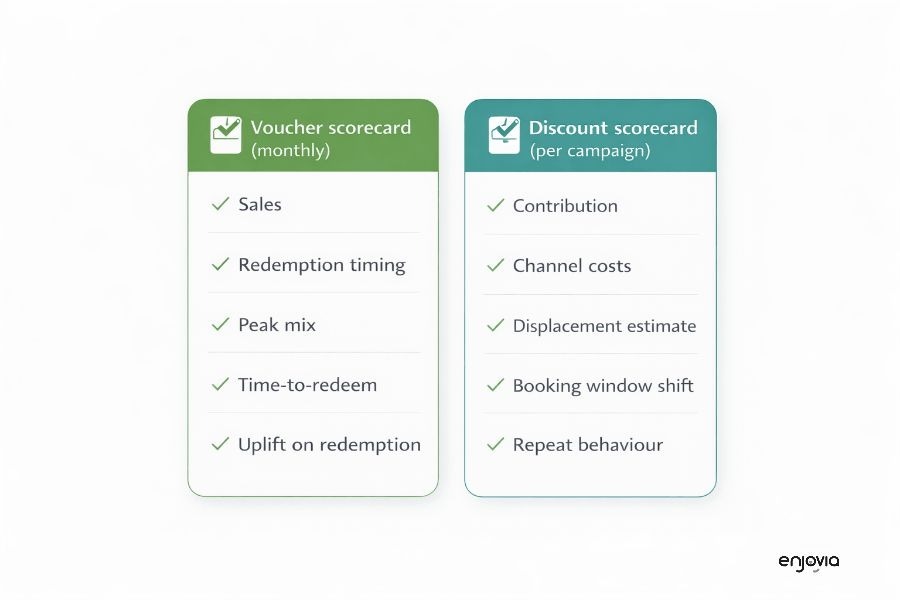
Vouchers and discounts need different success metrics. Vouchers are a value-and-commitment lever that often improves cash timing, so you measure redemption behaviour and whether redemptions land on peak dates. Discounts are a margin trade, so you measure contribution after channel costs and estimate displacement, not just occupancy.
Voucher scorecard (monthly)
- Voucher sales value and channel mix
- Redemption timing and redemption rate (by month of issue)
- Peak vs off-peak redemption mix
- Average time-to-redeem
- Uplift on redemption (spend above voucher value)
Discount scorecard (per campaign)
- Incremental contribution after variable costs and channel costs
- Channel costs (OTA, paid media, card fees)
- Displacement estimate (even if rough)
- Booking window shift (pulled forward vs new demand)
- Repeat behaviour without a discount
When this advice is less effective
Avoid pushing vouchers if you are consistently full at peak and cannot control redemption timing, because you risk displacing full-rate bookings and creating service pressure. Avoid broad public discounting if you cannot evidence incrementality, because you risk rate anchoring and weaker revenue performance even when occupancy rises.
FAQs
Are vouchers “free money”?
No. They create a service obligation until redeemed. They can still be a strong lever, but only if you can service redemption without displacing higher-margin trade or creating guest friction.
Will discounting damage my long-term rate?
It can. If discounts are frequent and public, guests anchor on the lower price and you often need repeated deals to maintain volume.
Can we run vouchers and discounts at the same time?
Sometimes, but only if the objectives are separate. Vouchers can sit as stored value for gifting. Discounts can be a tactical clearance tool for specific low-demand windows. What usually undermines both is frequent public discounting that makes the voucher feel like poor value.
Do vouchers hurt future availability?
They can, if redemption clusters into peak periods. The fix is operational: simple redemption flow, clear rules, and reporting on peak mix so you can intervene early.
What costs should be included when judging discount performance?
At minimum: variable labour, housekeeping, laundry, breakfast/food costs, utilities uplift, and channel costs (OTA commission, paid media, card fees). If you leave out channel costs, discounts almost always look better than they are.
If you want a simple way to run vouchers with clear rules and track redemption behaviour without manual admin, Enjovia is built for operators doing exactly that.