Gift vouchers vs discounts for UK hotels
Most independent hotels reach for discounts when a week looks light. It’s understandable, but it can also reset your public price in a way that’s hard to unwind.
Gift vouchers are often the safer choice when you want to hold your prices and sell stays, meals, or experiences as gifts.
They can bring cash forward, but the bigger advantage is that they let you sell value in advance without teaching guests to wait for deals.
Discounts still have a place, especially for genuinely empty, perishable inventory in defined low-demand windows, but they need tight fences and clear measurement.
Decision rule (UK independents)
If you want to protect rate and sell giftable experiences in advance, vouchers are usually the safer lever. If you need to clear genuinely empty low-demand dates, discounts can work, but only when they are fenced and measured on contribution after variable costs and displacement risk.
Jump to (clickable anchor links)
- Should you use vouchers or discounts?
- Gift vouchers: when they work, where they go wrong, what to measure
- Discounts: when they work, where they go wrong, what to measure
- UK compliance: voucher VAT and pricing claims
- How to measure success (two scorecards)
- FAQs
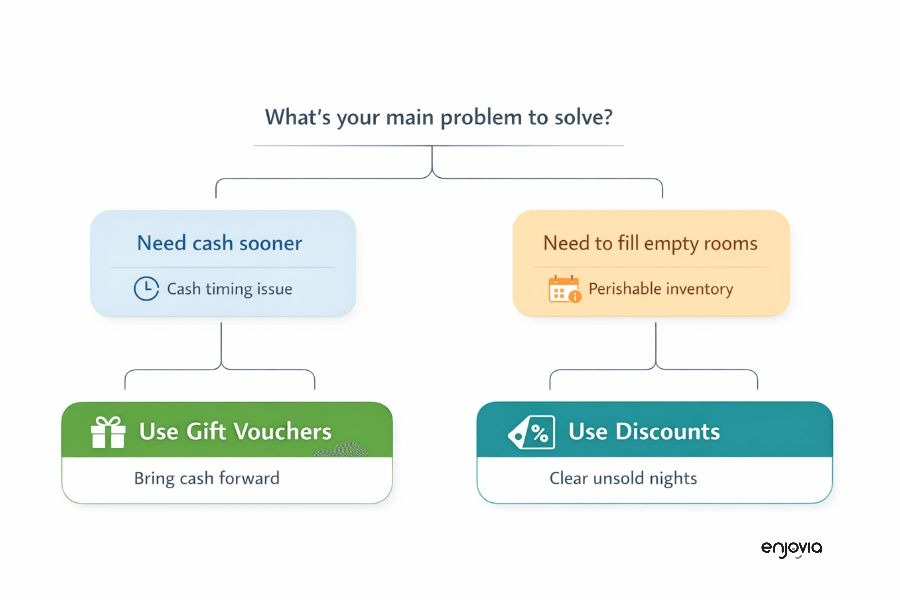
Should you use vouchers or discounts?
Before you choose a tactic, be clear what you’re trying to fix.
- Need to bring money forward without cutting public prices? Vouchers usually fit better.
- Need to fill specific quiet dates or time slots that would otherwise go unsold? A fenced discount can work, a discount with tight rules (dates, lead time, length of stay, audience, and inventory caps) so it clears quiet nights without teaching the market your new ‘normal’ price.
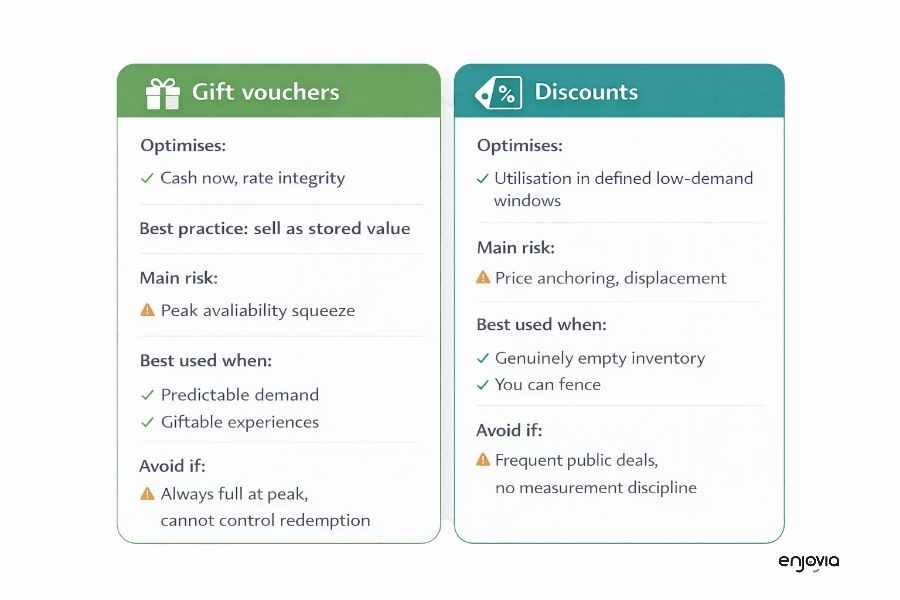
Gift Vouchers vs Discounts for UK Hotels - Gift vouchers (how they work, where they bite, what to track)
Gift vouchers let you sell stays, dining and experiences in advance without cutting your public price. The guest gets credit or a defined experience package. You get earlier revenue and a giftable product.
Two voucher formats, two risk profiles
- Stored value (recommended): acts like credit, so you keep rate integrity.
- Fixed-price packages (needs care): can become cheap on peak dates unless you use “from” pricing, supplements, or date rules.
Use vouchers when
- You want to protect rates but still create reasons to buy now.
- You have giftable experiences beyond rooms (lunch, afternoon tea, spa, seasonal menus).
- You can manage redemption so it doesn’t concentrate on peak weekends.
Where vouchers can go wrong
- Redemptions pile into peak periods because there’s no plan for availability.
- Costs rise between sale and redemption and margin gets squeezed.
- Terms aren’t clear, so your team ends up negotiating at reception.
If you want UK-specific background on the gift voucher law and expiry dates read more here: https://enjovia.com/gift-card-refund-law/
Avoid pushing vouchers hard if
- You’re consistently full at peak and can’t control redemption timing.
- Redemption is manual or clunky (lots of exceptions, phone calls, back-and-forth).
- You’re already under service pressure.
What to track (monthly)
- Voucher sales value and channel mix
- Redemption timing and redemption rate (by month of issue)
- Peak vs off-peak redemption mix
- Average time-to-redeem
- Uplift on redemption (spend above voucher value)
- Guest friction (refund requests, booking complaints)
Optional context on why experience-led offers hold value better than blunt price cuts:
Why experience-led vouchers convert
Here’s one example of a hotel using vouchers as an advance sales channel at scale (useful for context, not a benchmark): Celtic Manor voucher sales example
Discounts (when they work, where they backfire, what to track)
Discounts are a price lever. They can fill genuinely empty dates, but they also teach the market what your lowest price looks like. The safest way to use them is as a fenced, time-bound clearance tool.
Use discounts when
- You have inventory that will otherwise go unsold in a defined window.
- You can fence it by dates, lead time, length of stay, and audience.
- You can measure contribution after costs, not just pickup.
Fence it like an operator
- Midweek only (or Sun–Thu only)
- Advance purchase (reduces last-minute cannibalisation)
- Minimum length of stay in shoulder periods
- Member or email-only access (avoid public anchoring)
- Tight inventory limits
Where discounts go wrong
- Displacement: bookings that would have happened at a higher rate without the discount.
- Price anchoring: the discounted price becomes the “real” price in guests’ minds.
Discounting can create bookings fast, but it can also give away rate you didn’t need to give away. Cornell’s hotel pricing research found a recurring pattern: hotels that undercut similar nearby competitors often see occupancy rise, while RevPAR performance falls behind that same group.
Source: Canina & Enz (2006), Cornell Center for Hospitality Research,Why Discounting Still Doesn’t Work: A Hotel Pricing Update.
Avoid broad discounting if
- You can’t clearly say which inventory it’s meant to clear.
- You’re discounting so often that guests learn to wait.
- You can’t measure contribution after variable and channel costs.
What to track (per campaign)
- Incremental contribution after variable costs and channel costs
- Channel costs (OTA commission, paid media, card fees)
- Displacement estimate (even if rough)
- Booking window shift (pulled forward vs genuinely new)
- Repeat behaviour without a discount
- Rate integrity signals (deal-only behaviour, price matching)
UK compliance: promotional pricing claims
This isn’t legal advice, but if you show savings (“was/now”, “20% off”), countdown timers, or scarcity messages, make sure you can evidence the reference price and present the offer transparently. The CMA has published compliance advice on pricing and urgency claims for businesses.
Source: CMA compliance advice (open letter). (assets.publishing.service.gov.uk)
How to measure success (so you don’t fool yourself)
It’s easy to convince yourself something “worked” because you saw activity. Voucher sales come in. Occupancy ticks up. The only way to avoid fooling yourself is to measure each lever on the metric that matches what it’s actually doing.
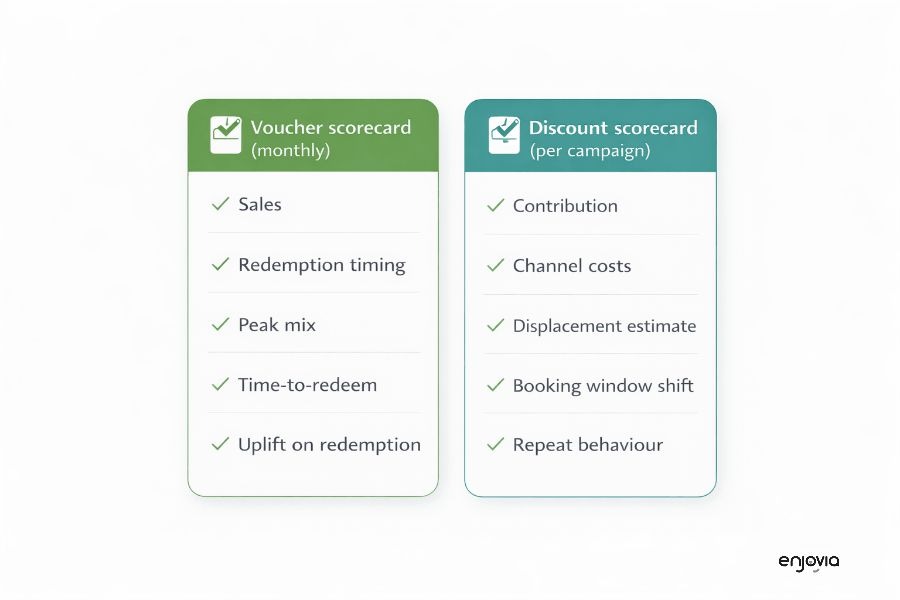
Vouchers and discounts need different success metrics. Vouchers are a value-and-commitment lever that often improves cash timing, so you measure redemption behaviour and whether redemptions land on peak dates. Discounts are a margin trade, so you measure contribution after channel costs and estimate displacement, not just occupancy.
Voucher scorecard (monthly)
- Voucher sales value and channel mix
- Redemption timing and redemption rate (by month of issue)
- Peak vs off-peak redemption mix
- Average time-to-redeem
- Uplift on redemption (spend above voucher value)
Discount scorecard (per campaign)
- Incremental contribution after variable costs and channel costs
- Channel costs (OTA, paid media, card fees)
- Displacement estimate (even if rough)
- Booking window shift (pulled forward vs new demand)
- Repeat behaviour without a discount
When this advice is less effective
Avoid pushing vouchers if you are consistently full at peak and cannot control redemption timing, because you risk displacing full-rate bookings and creating service pressure. Avoid broad public discounting if you cannot evidence incrementality, because you risk rate anchoring and weaker revenue performance even when occupancy rises.
FAQs
Are vouchers “free money”?
No. They create a service obligation until redeemed. They can still be a strong lever, but only if you can service redemption without displacing higher-margin trade or creating guest friction.
Will discounting damage my long-term rate?
It can. If discounts are frequent and public, guests anchor on the lower price and you often need repeated deals to maintain volume.
Can we run vouchers and discounts at the same time?
Sometimes, but only if the objectives are separate. Vouchers can sit as stored value for gifting. Discounts can be a tactical clearance tool for specific low-demand windows. What usually undermines both is frequent public discounting that makes the voucher feel like poor value.
Do vouchers hurt future availability?
They can, if redemption clusters into peak periods. The fix is operational: simple redemption flow, clear rules, and reporting on peak mix so you can intervene early.
What costs should be included when judging discount performance?
At minimum: variable labour, housekeeping, laundry, breakfast/food costs, utilities uplift, and channel costs (OTA commission, paid media, card fees). If you leave out channel costs, discounts almost always look better than they are.
If you want a simple way to run vouchers with clear rules and track redemption behaviour without manual admin, Enjovia is built for operators doing exactly that.
Quick answer (operator decision)
Sell gift vouchers (gift cards) when you need a simple prepay product and can let the customer choose the details later.
Sell experience packages when you need to lock in what’s included and protect capacity and margin.
Use a hybrid if you want easy gifting but controlled delivery: voucher purchase, package-style redemption.
Watch-outs: vouchers can create peak redemption spikes and admin; packages can cause friction if availability or costs change.
Monetary vs experience vouchers: which should an operator sell?
This isn’t a debate about gifts. It’s a choice about prepaid revenue and fulfilment control.
A gift voucher (gift card) can be sold as monetary value (stored credit redeemed later) or as an experience voucher (a defined service or bundle, delivered later).
The real question is where uncertainty sits, and whether your operation can absorb it.
Definitions (for consistency across regions)
Gift card / gift voucher / gift certificate / experience voucher (gift experience): different labels operators use for prepaid vouchers. The wording varies by region and by business, but the underlying concept is the same: customers pay now and redeem later.
Two common voucher formats:
- Monetary voucher: a stated cash value (for example, £50) that can be redeemed against eligible services (unless you apply restrictions).
- Experience voucher (gift experience): a voucher sold as a defined experience, either one service (for example, “afternoon tea”) or a bundle/package (for example, “spa treatment + lunch”), delivered later under stated rules.
The real operator question: where does uncertainty sit?
Both monetary vouchers and experience vouchers take payment upfront and are redeemed later. In most cases, the guest still chooses the booking date and time after purchase.
The difference is what is fixed at the point of sale:
Monetary vouchers keep the product choice open. The buyer selects a value (for example, £50) and the recipient decides later what to spend it on. That flexibility reduces purchase friction, but it can increase “what can I use this for?” queries and makes demand harder to steer unless your redemption rules and booking journey are tight.
Experience vouchers fix the product, not the schedule. The buyer commits to a defined experience (one service or a bundle), but the date and time are usually booked later within the validity window. This helps you protect margin and delivery consistency because inclusions are clear. The trade-off is obligation: if you can’t deliver that specific experience as sold, you’re managing substitutions, refunds, and goodwill.
For mainly countries like the UK, voucher structure can matter for VAT or Sales Tax treatment, so it’s worth aligning definitions early with your tax authorities' guidance.
When should an operator sell monetary gift vouchers (gift cards)?
Best when: you want one simple prepay product, and you’re happy for the recipient to choose the service later.
Monetary vouchers fit operations with a wide range of services, variable availability, or gift buyers who can’t confidently pick the right experience.
Watch for: more questions at redemption and more peak pressure if booking rules aren’t tight. Expect “what can I use this for?”, partial-use admin, and upgrade difference-charging to become recurring work.
When should an operator sell experience vouchers (gift experiences)?
Best when: you want the booking date to stay flexible, but you need clarity on what will be delivered.
Experience vouchers work well when inclusions can be defined cleanly (one service or a bundle), when margin control matters, or when capacity and partner delivery need tighter rules.
Watch for: obligation. If inclusions, partners, or operating conditions change, you’ll see more substitution, goodwill, and refund conversations because the customer bought a specific experience.
Comparison table: monetary vouchers vs experience vouchers
| What changes for the operator | Monetary voucher (gift card) | Experience voucher (gift experience) |
| Buyer effort at purchase | Lowest | Slightly higher |
| What’s fixed at purchase | Value only | The experience (service/bundle) |
| Capacity and peak control | Needs strict booking rules | Easier to steer with defined offers |
| Support load | More eligibility/partial-use questions | More substitution/expectation questions |
| Margin control | Can leak through upgrades/goodwill | Stronger through defined inclusions |
| Main dispute risk | “What can I use this for?” + balance/terms | “Deliver as described” + substitutions |
The practical middle ground: voucher controls and add-ons
Most operators don’t choose one format and stop. They add simple controls to protect peak capacity, and add-ons to lift value without creating redemption arguments.
Controlled monetary vouchers
What it is: a cash-value voucher with clear rules, for example weekday-only, off-peak only, or limited to a department (spa-only, dining-only).
Why it works: the product stays easy to buy, but you gain a lever to steer demand and protect peak slots.
Watch-outs: if restrictions feel hidden or inconsistently applied, disputes rise. Put the rule in plain language at purchase and apply it the same way every time.
Experience vouchers with add-ons
What it is: a defined experience voucher with optional upgrades at purchase (for example weekend upgrades, add-on elements, extended duration).
Why it works: the experience stays defined, but buyers can personalise and trade up without you relying on staff to negotiate at redemption.
Watch-outs: upgrades must be priced and applied consistently, or you’re back to manual exceptions.
Which to use? If peak capacity is the risk, start with controlled monetary vouchers. If margin drift and substitutions are the risk, start with experience vouchers and clearly priced add-ons.
Redemption check: is the booking path clear?
With a good voucher management system, both monetary and experience vouchers can be easy to redeem. The operational difference shows up when your booking path and rules aren’t clear.
If customers can self-serve redemption and booking, either format scales well. If redemption relies on staff manually interpreting terms, support load rises, and small exceptions become routine. The voucher format matters less than whether redemption is predictable and self-serve.
Voucher economics: overspend and breakage (useful, but not guaranteed)
Voucher programmes often show breakage (unused vouchers) and overspend (spend above voucher value). A hotel industry guide reports both patterns in hotel voucher sales. (hotelcms-production.imgix.net)
Treat these as variables, not promises. Breakage can trigger disputes if policies are unclear or feel unfair. Overspend is far more likely when booking is smooth and upgrades are easy to purchase, and far less likely when availability is constrained.
Expiry, refunds, and legal risk (decision-level)
Rules vary by jurisdiction, but the risk profile differs by voucher format.
Monetary vouchers tend to trigger balance and eligibility questions: what the value can be used for, what’s excluded, and disputes about terms, fees, or expiry.
Experience vouchers tend to trigger delivery questions: whether the experience matches what was sold, substitutions, and cancellations when the original experience can’t be delivered.
US (federal vs state): there’s a federal baseline on gift card expiry and fees, and state law can add extra rules. For the plain-English breakdown, see: https://enjovia.com/gift-card-expiration-date-federal-law/
UK (refunds): outcomes depend on the situation, but most disputes come down to policy clarity and consistency. For common scenarios, see: https://enjovia.com/gift-card-refund-law/
For a cross-market view of expiry approaches, see: https://enjovia.com/gift-card-expiration-law
If you want a practical way to reduce disputes, this wording template shows how operators can write voucher terms clearly (including restrictions and redemption rules): https://enjovia.com/gift-certificate-wording-template/
How to tell if your voucher setup is working (first 90 days)
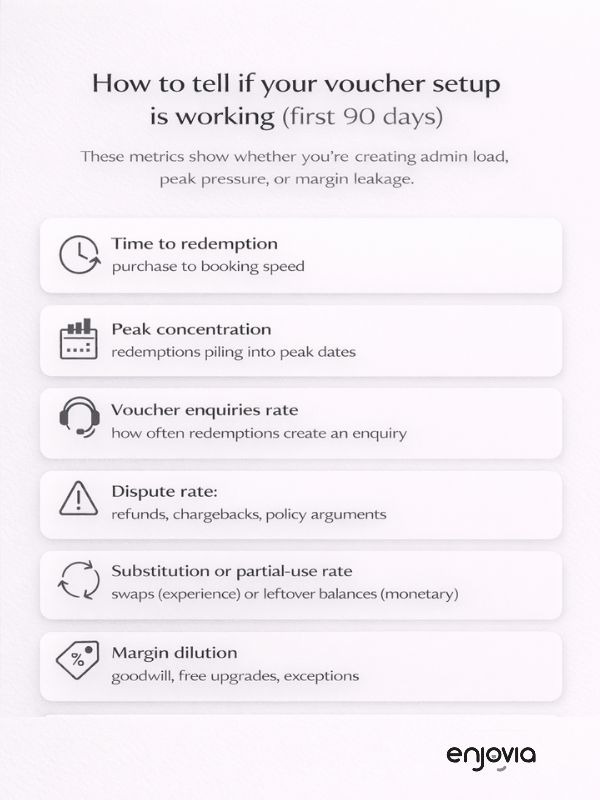
These metrics show whether you’re creating admin load, peak pressure, or margin leakage.
- Time to redemption: purchase to booking speed
- Peak concentration: redemptions piling into peak dates
- Voucher enquiries rate: how often redemptions create an enquiry
- Dispute rate: refunds, chargebacks, policy arguments
- Substitution or partial-use rate: swaps (experience) or leftover balances (monetary)
- Margin dilution: goodwill, free upgrades, exceptions
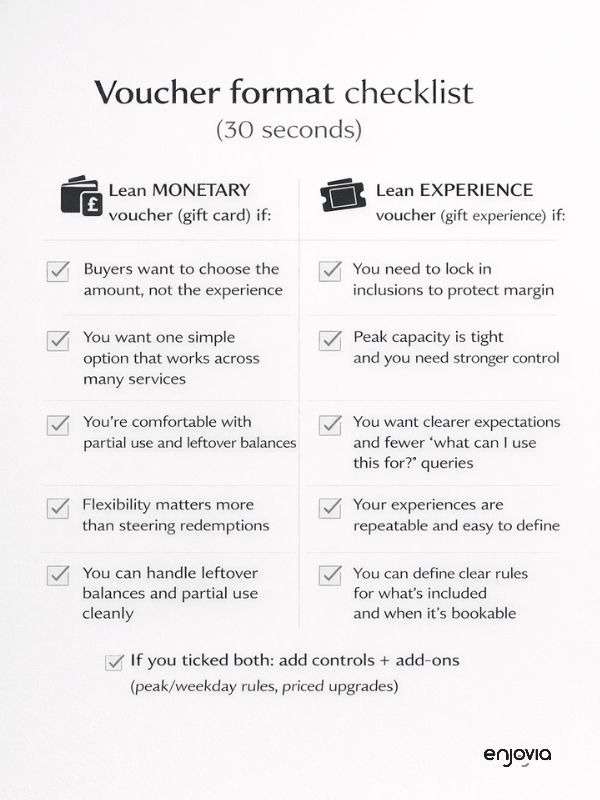
Monetary Voucher vs Experience Voucher - Voucher format checklist (30 seconds)
Tick the statements that are true.
Lean MONETARY voucher (gift card) if:
- Buyers want to choose the amount, not the experience
- You want one simple option that works across many services
- You’re comfortable with partial use and leftover balances
- Flexibility matters more than steering redemptions
Lean EXPERIENCE voucher (gift experience) if:
- You need to lock in inclusions to protect margin
- Peak capacity is tight and you need stronger control
- You want clearer expectations and fewer “what can I use this for?” queries
- Your experiences are repeatable and easy to define
If you ticked both: keep purchase simple, then add controls (peak/weekday rules) and add-ons (priced upgrades) to avoid negotiation at redemption.
The simplest decision rule- Monetary Voucher vs Experience Voucher
If your biggest problem is purchase friction, lead with monetary vouchers.
If your biggest problem is delivery control, lead with experience vouchers.
If you need both, keep purchase simple but use controls (peak rules) and add-ons (priced upgrades) so redemption doesn’t turn into negotiation.
Next step: If you want to reduce disputes, use this voucher terms wording template: https://enjovia.com/gift-certificate-wording-template/
FAQ
Can we sell both monetary and experience vouchers without confusing guests?
Yes, as long as the difference is obvious at purchase. Monetary vouchers should be framed as “value to spend”, while experience vouchers should show exactly what’s included. Confusion usually comes from vague naming and unclear redemption rules, not from offering both.
Should we restrict monetary vouchers to off-peak or weekdays?
Restrict them when peak capacity is the constraint and you need a lever to steer demand. Keep restrictions simple (weekday-only or off-peak only), display them clearly before payment, and apply them consistently to avoid disputes.
What causes the most disputes with monetary vouchers?
Eligibility and policy clarity: what the voucher can be used for, what’s excluded, whether it can be split across visits, and how upgrades or price differences are handled. Clear terms and a predictable booking path prevent most problems.
How do we reduce exceptions and “can I change this?” requests on experience vouchers?
Make the inclusions and booking rules explicit at purchase: what’s included, what isn’t, when it can be booked, and how upgrades are priced. The fewer grey areas you leave, the less your team has to interpret requests at redemption.
TL;DR (Key Summary)
Instagram hotel marketing is effective because it reaches travellers where they discover new stays. Hotels that share authentic content, timely offers, and direct booking or voucher links turn casual scrolling into real revenue.
With tools like Enjovia, you can link that content directly to a checkout page. This guide shows how to build a strategy that fits how your guests already browse, plan, and book.
Instagram for Hotels: How to Turn Scrolls Into Stays
Instagram is more than a place to share photos. For hotels, it is often where guests first notice you, picture the stay, and begin to plan a trip. When it is used with purpose, it can move people from browsing to booking a room or buying a gift voucher.
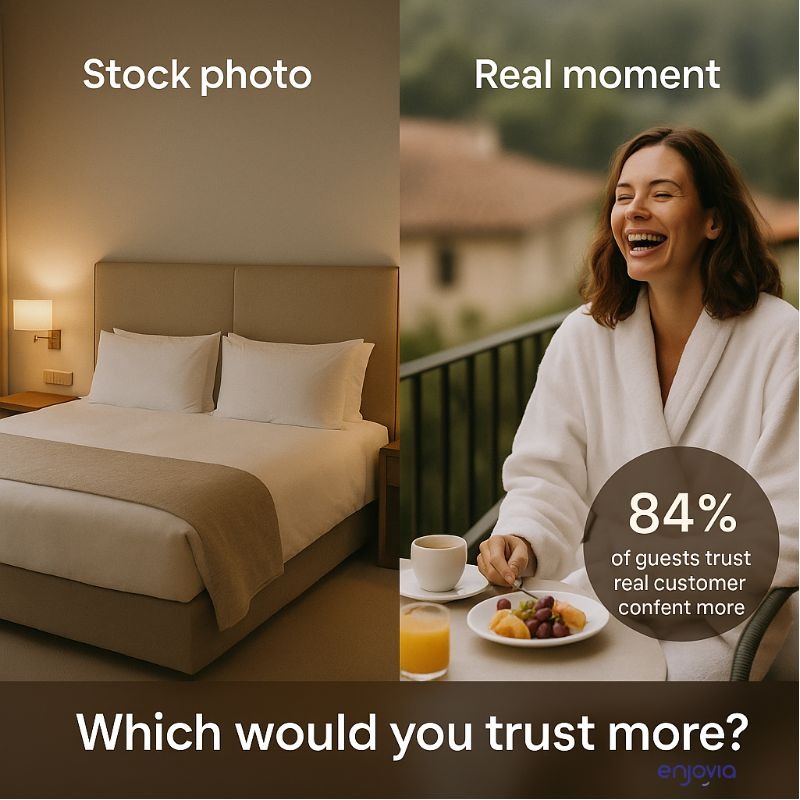
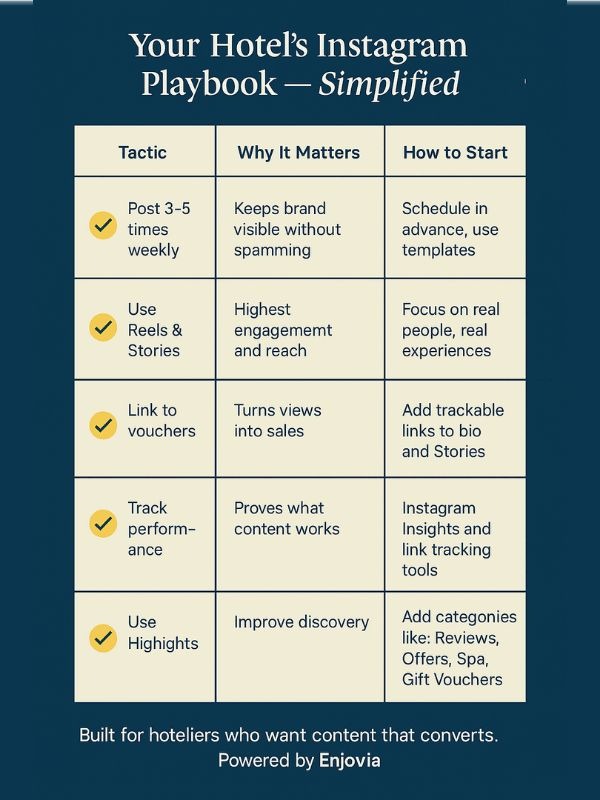
Research backs this up. Blastness found that 61% of travellers have booked after discovering a hotel on Instagram. MGT Design reports that Reels and Stories get 49% more engagement than still posts, and people are more likely to act after watching a video. Keevee’s survey shows that 84% of younger travellers place more trust in brands when they see real guest content, which often outperforms polished advertising.
This is a clear opportunity. Instagram plants the idea of a stay, and with the right setup it can also be where guests make a purchase. Gift vouchers work especially well because they are quick to buy, simple to share, and easy to feature in posts or Stories.
Want to go deeper? Check out our guide on how to sell hotel gift vouchers online.
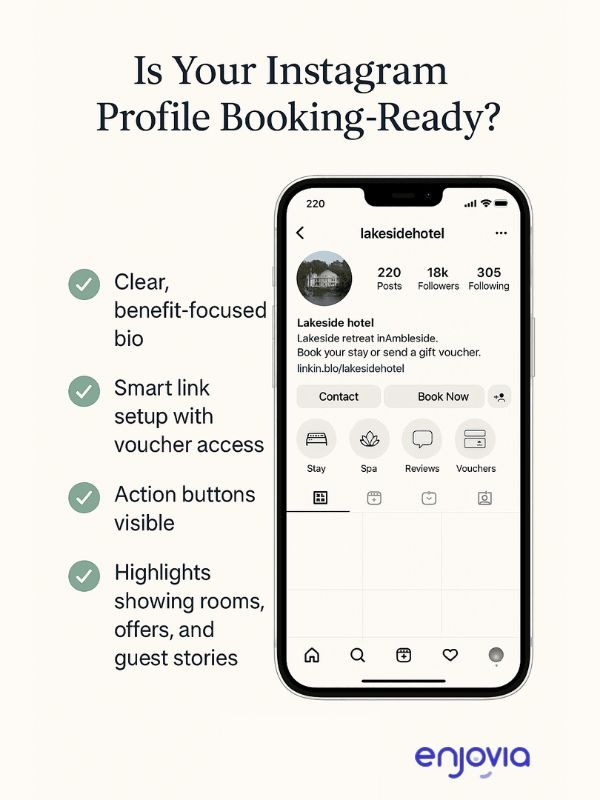
How to Set Up Your Hotel’s Instagram Profile to Drive Bookings
Your profile is often the first thing a potential guest sees, so it should make booking or buying a voucher feel like the obvious next step. A few small changes can make that happen.
Start with a Business Profile
Switching from a personal account gives you tools that matter. Guests can call or email without hunting for your details, and you can track which posts get the most attention. You also get space to add direct links to your booking page or voucher shop, which builds trust straight away.
Write a Bio That Guides Action
Use one clear line to say what you offer and what to do next. For example: “Luxury coastal retreat in Cornwall. Book your stay or send a gift voucher.” Skip hashtags and emojis here - the point is to make the choice simple.
Add a Link That Works Hard
Whether you use Linktree, Later, or your own page, make sure it includes:
- A booking link
- A gift voucher link
- Any seasonal packages
Put the most useful link at the top so guests see it first.
Use Highlights for What Guests Want Most
Highlights are one of the first things people tap, so give them quick answers and inspiration. Popular categories include Rooms, Gift Vouchers, Reviews, Local Tips, and Offers. Keep the titles short and the covers clean.
Make It Easy to Act
If your booking or voucher system connects to Instagram, add the buttons to your profile. That way guests can act on the moment without messaging or extra clicks.
Content That Converts (Not Just Gets Likes)
A great-looking grid might make someone stop for a second, but that alone won’t keep your rooms full. What works better is the kind of post that feels like it came from an actual stay. The ones that get people clicking, messaging, or sending it to a friend saying, “This place looks good, should we go?”
Show What It Is Really Like
Highly polished hotel shots can be nice, but they often feel a bit too perfect. People tend to connect with signs that someone’s just been there. Maybe it’s a half-finished breakfast left out on the balcony, or muddy shoes kicked under a chair after a long walk. Even a guest’s towel still hanging over the hot tub rail in the background of a photo. Little clues like that feel inviting.
Focus on the Feeling
You’re not only selling a room for the night. You’re selling the mood that comes with it. Think of that quiet pause before the day starts, the way the sea sounds when you lean out over the terrace, or the low crackle of the fire in the lounge while people are talking nearby. A line like “First coffee on the patio while the tide rolls in” does more work than “Two-night stays available.”
Use Video to Pull People In
Short clips tend to travel further than still photos and give a better sense of the place. A quick Reel might take someone from the reception desk to the view outside in under half a minute. Stories are perfect for whatever is happening right now. A flash offer, tonight’s dessert special, or a quick hello from the team. You don’t need fancy editing. Hold the camera steady, catch the moment, and post.
Use Your Best Ideas Twice
If a post lands well, don’t let it get lost. Bring it back in a Story, pin it to your profile, or recreate it with a slightly different angle. Most of your followers won’t have seen it the first time anyway.
Content Format Cheat Sheet
| Format | Best For |
| Reels | Storytelling, reach, showing atmosphere |
| Stories | Quick updates, offers, behind-the-scenes |
| Grid Posts | Room photos, seasonal themes, mood shots |
| Highlights | FAQs, packages, voucher information |
You don’t have to use every format all at once. Pick the ones that actually work for your audience and do those well.
Instagram Hotel Marketing: A 7-Day Content Plan to Increase Bookings and Voucher Sales
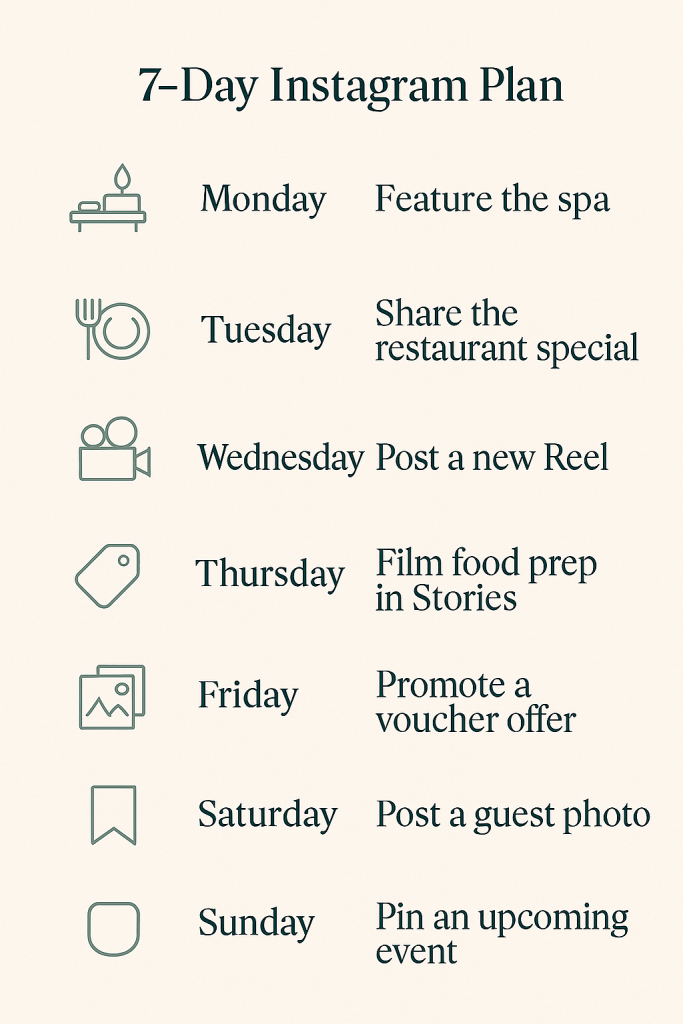
Posting regularly keeps your hotel in mind when guests are ready to book. This seven-day plan gives you a mix of content that builds trust, sparks interest, and points directly to packages or vouchers.
Monday: Grid photo of a package guests can book now (e.g., “2 nights + wine tasting”), add booking link in bio
Tuesday: Reel of an in-room surprise upgrade with “Book direct for perks like this” text
Wednesday: Story poll on two seasonal offers, link to book the winner immediately
Thursday: 15-second chef tip or breakfast recipe reel to showcase your dining
Friday: Story countdown for final spa vouchers before they’re gone
Saturday: Repost a guest’s Story with their words and your booking link
Sunday: Refresh Highlights with your top 3 bookable offers for the month and add one local insider tip tied to a package - something they wouldn’t find in a travel guide but will get if they book with you
It’s a rhythm you can repeat, adjust, and build on. The goal is not more content for the sake of it, but more posts that give guests a reason to act.
How Hotels Turn Reels into Bookings
Short videos can lead directly to bookings when they feel real. A quick clip of a guest arriving, the view from a balcony, or someone relaxing in the spa can help viewers picture themselves there. Add a booking link or voucher prompt so they know what to do next.
Measure What Matters
Likes and comments are easy to count, but actions that show intent are more valuable. Track clicks to your booking page, voucher sales, or other steps that bring a guest closer to booking. A weekly check is enough to see what’s working.
Signs your content is making an impact:
- A guest finds you through a Reel and visits your site within the week
- Voucher sales rise after a burst of Story engagement
- Countdown posts with voucher links lead to a short-term spike in sales
Check Instagram Insights weekly to see which posts get the most replies, saves, or clicks. Compare them to your usual results and reuse formats that perform best. If you sell vouchers, link specific posts to those offers and track with promo codes, unique links, or landing page visits.
Some guests will see you a few times before booking. Staying consistent and giving clear ways to act often turns interest into sales.
How to Track Instagram’s Impact on Voucher Sales
Many hotels post on Instagram and hope for the best. The ones turning it into revenue focus on the actions that lead to bookings, not just the likes.
Gift vouchers make this easy to measure. They give you a direct link between a post and a sale, so you can see which content is moving people to buy.
Trackable signs your posts are working:
- Clicks on your bio link that lead to the voucher page
- Reels or Stories that drive visitors to your website
- Promo codes redeemed from a specific post
- Replies to polls or countdowns tied to a limited-time offer
Example:
A coastal boutique hotel promoted a “Weekend Spa Escape” voucher in Stories. They added a countdown sticker and capped the offer at 25 redemptions. Within days, it sold out. Most buyers were local followers who saw the post, shared it, and bought it as a last-minute gift.
Why this matters:
When you know what prompts action, you can double down on the content that fills rooms and sells packages. Start with one clear campaign, such as a seasonal spa package or weekend break. Mention it in your caption or bio, add a trackable link or promo code, and monitor results for a week. Compare it to a regular post and use what you learn to shape your next offer.
Make Your Instagram Work Harder for Your Hotel
Views don’t equal bookings. Guests might watch Reels or tap Stories, but revenue comes when it’s simple to take the next step.
Share genuine moments, highlight bookable offers, and make sure your voucher or booking links are easy to find where people are already engaging with your content.
What to do this week:
- Review your bio and mention gift vouchers or bookable stays
- Update your Smart Link so booking and voucher options are first
- Run a Story campaign with a countdown and voucher link
- Add Highlights for rooms, reviews, and special offers
- Pick one offer in your Enjovia dashboard to promote for the next 7 days
Turn Instagram Followers into Guests and Buyers
If your posts inspire people, give them a way to act on it.
With Enjovia, you can link Instagram content directly to voucher sales, flash offers, and bookable packages- all trackable, so you can see what drives revenue.
Ready to turn likes into bookings? See how Enjovia connects your content to real sales.
FAQs About Using Instagram for Hotels
Q: How often should I post?
Q: Can guests really buy a voucher straight from Instagram?
Q: What actually works for getting bookings?
Q: How do I know if Instagram’s doing anything?
Q: Any features worth turning on?
Q: Do hashtags still matter?